
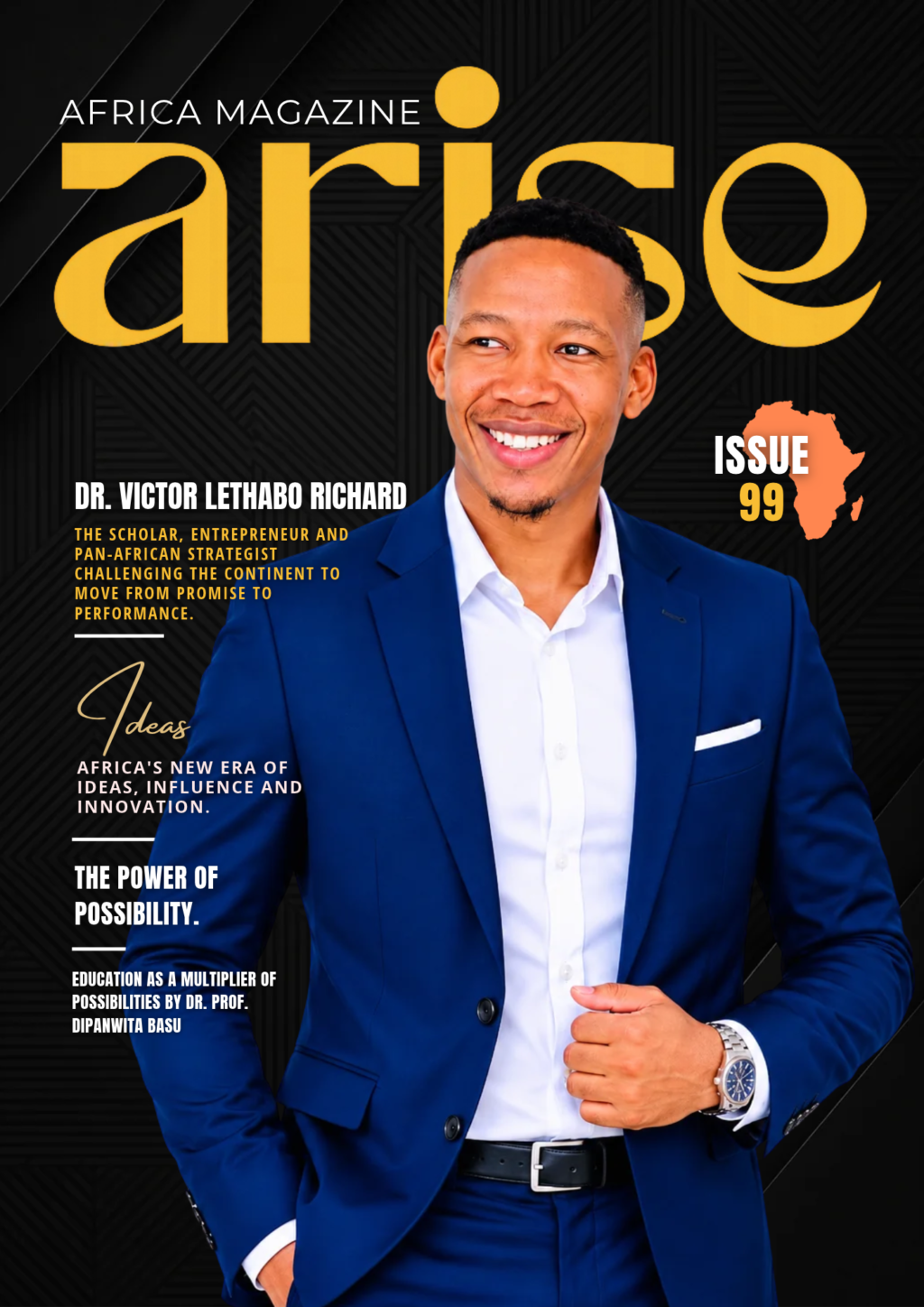
From engineering and business to governance, research and continental development, the Botswana-born scholar-practitioner believes Africa’s future depends on transforming knowledge, resources and ambition into measurable results.
Africa has long been described as a continent of immense potential. Its mineral wealth, agricultural resources, youthful population and entrepreneurial spirit continue to attract global attention. Yet a fundamental question remains: how does Africa translate its potential into sustainable economic transformation and prosperity? For Dr. Victor Lethabo Richard, the answer lies in moving beyond ambition towards practical implementation. An engineer, scholar, entrepreneur and Pan-African development advocate from Ramotswa, Botswana, Richard believes Africa needs leaders who can connect technical expertise, strategic leadership, policy and economic development. His journey reflects a commitment to education, discipline and the belief that knowledge must serve a purpose beyond individual advancement. From engineering to business, governance and research, his professional evolution has been driven by a desire to understand Africa’s challenges and contribute to solutions.
FROM ENGINEERING TO STRATEGIC LEADERSHIP
Richard began his professional journey in electrical and industrial engineering, developing an understanding of infrastructure, technology, systems and operational efficiency. However, he recognised that technical expertise alone could not address the complex challenges facing organisations and societies. This realisation motivated him to pursue an MBA and subsequently a Doctor of Business Administration (DBA), alongside ongoing legal studies.
His academic journey reflects a desire to understand how institutions are governed, economies grow, investments are structured and policies influence development. Coming from Ramotswa, Botswana, he attributes his outlook to values of hard work, discipline, community and education. His journey has required sacrifice, persistence and personal investment, reinforcing his belief that meaningful progress demands consistency. “Education should not simply elevate an individual; it should equip that individual to contribute to the advancement of society,” he believes. For Richard, leadership is not determined by titles but by the problems one is willing to solve. This philosophy informs his involvement in Pan-African research, continental development, trade integration and youth empowerment.
BUILDING INSTITUTIONS THAT OUTLIVE THEIR FOUNDERS
Richard’s vision is reflected in Pan African Integrated Solutions (PAIS) and Richard Technologies Investment Group (RTIG), initiatives focused on development, investment, innovation and economic transformation. PAIS connects research, policy development, strategic consulting, continental trade and development partnerships, bringing together governments, businesses, development partners, researchers, investors and young people to strengthen institutional capacity and economic cooperation. RTIG reflects his entrepreneurial vision, focusing on technology, strategic investment, innovation and business development. Together, the institutions represent his ambition to build sustainable structures that contribute to Africa’s future beyond individual achievement. “My ultimate ambition is not simply to establish organisations that carry my name. It is to build institutions that can outlive their founders and contribute meaningfully to Africa’s economic future,” he says. PAIS’s guiding philosophy is captured in three words: Unity. Connectivity. Growth.
THE AFRICA THAT MUST MOVE FROM EXTRACTION TO VALUE CREATION
Richard believes one of Africa’s greatest obstacles is the disconnect between policy ambition, institutional capacity and implementation. Despite its resources and entrepreneurial talent, the continent continues to face fragmented markets, inadequate infrastructure, limited industrial capacity and dependence on raw-material exports. The challenge, he argues, is transforming resources into industries, employment and sustainable economic value. “We cannot continue exporting raw materials, importing finished products, and expecting that model to deliver sustainable economic independence.” His proposed solutions include industrialisation, local processing, manufacturing, regional production networks, governance reform, infrastructure integration, access to finance and human-capital development. Transport, energy, digital infrastructure and logistics must connect African economies more effectively, while businesses need capital and investment partnerships that support productive activity. For Richard, transformation requires coordinated continental thinking and a deliberate shift from resource extraction towards value creation. Africa must move from being celebrated for what it could become to being recognised for what it delivers.
MAKING AFRICAN INTEGRATION WORK FOR ORDINARY PEOPLE
The African Continental Free Trade Area (AfCFTA) presents a major opportunity for economic integration. However, Richard believes its success must be measured by tangible outcomes rather than agreements signed or conferences held. The real indicators are businesses expanding across borders, young people securing employment, increased intra-African trade and greater economic value retained within the continent. Achieving this requires investment in digital trade, manufacturing, agriculture, logistics and agro-processing, alongside accessible trade finance and practical trade education. Entrepreneurs must understand customs procedures, rules of origin, export documentation, product standards and cross-border regulations to access continental markets. Richard believes organisations such as PAIS can bridge the gap between continental policy and business-level implementation. His message to entrepreneurs is clear: “Do not see Africa as 54 separate markets. Begin to see Africa as one interconnected economic opportunity.”
KNOWLEDGE AS A CATALYST FOR CHANGE
Research and intellectual development remain central to Richard’s journey. His interests span industrial development, governance, artificial intelligence, public policy, infrastructure, supply-chain resilience and African economic integration. He is the author of Africa Integrated: Trade, Peace, Human Rights & the Future of Continental Prosperity, reflecting his interest in the relationship between economic integration, peace, human rights and development. His professional development has included programmes and engagements associated with UNITAR, GOPAC, ROLACC, ICAR, CFI, Yale, Johns Hopkins, UNESCO, Oxford Saïd Business School and other institutions. For Richard, knowledge must extend beyond academic institutions to inform decision-making, strengthen institutions, influence policy and deliver practical solutions, particularly as technology and artificial intelligence reshape Africa’s opportunities.
A CHALLENGE TO THE NEXT GENERATION
Richard’s message to young Africans centres on personal responsibility, discipline and continuous development. He believes young people must invest in themselves before expecting the world to invest in them. He encourages intellectual curiosity, practical competence, relationship-building and pursuing impact rather than recognition. Qualifications must be accompanied by the ability to deliver results, understand businesses, embrace technology and solve problems. Young Africans must also build relationships beyond geographical boundaries and recognise the value of collaboration across countries, industries and institutions. His advice to those waiting for perfect conditions is to begin with what they have, develop what they know and build progressively. Leadership, he emphasises, is not reserved for political office; it can be exercised through research, entrepreneurship, technology, agriculture, education, public service and community development. “Africa does not need another generation that only identifies problems. It needs a generation that takes responsibility for solving them.” The challenge is to move from being spectators of Africa’s development to becoming architects of its transformation.
THE AFRICA WE MUST BUILD
Richard believes Africa’s future must be deliberately designed and collectively pursued. The continent must invest in its people, strengthen institutions, industrialise, integrate markets and create opportunities for the next generation. Its resources and intellectual capacity must be matched by effective execution. For him, confidence in Africa’s future requires the courage to challenge outdated systems, the discipline to implement ideas and the commitment to turn ambition into measurable results. His vision extends beyond personal success to a stronger, more integrated, prosperous and self-reliant Africa.Africa’s potential is undeniable, but potential alone is not transformation. The Africa we want will not emerge by accident. It must be built through knowledge, innovation, integrity, leadership and collective action.